


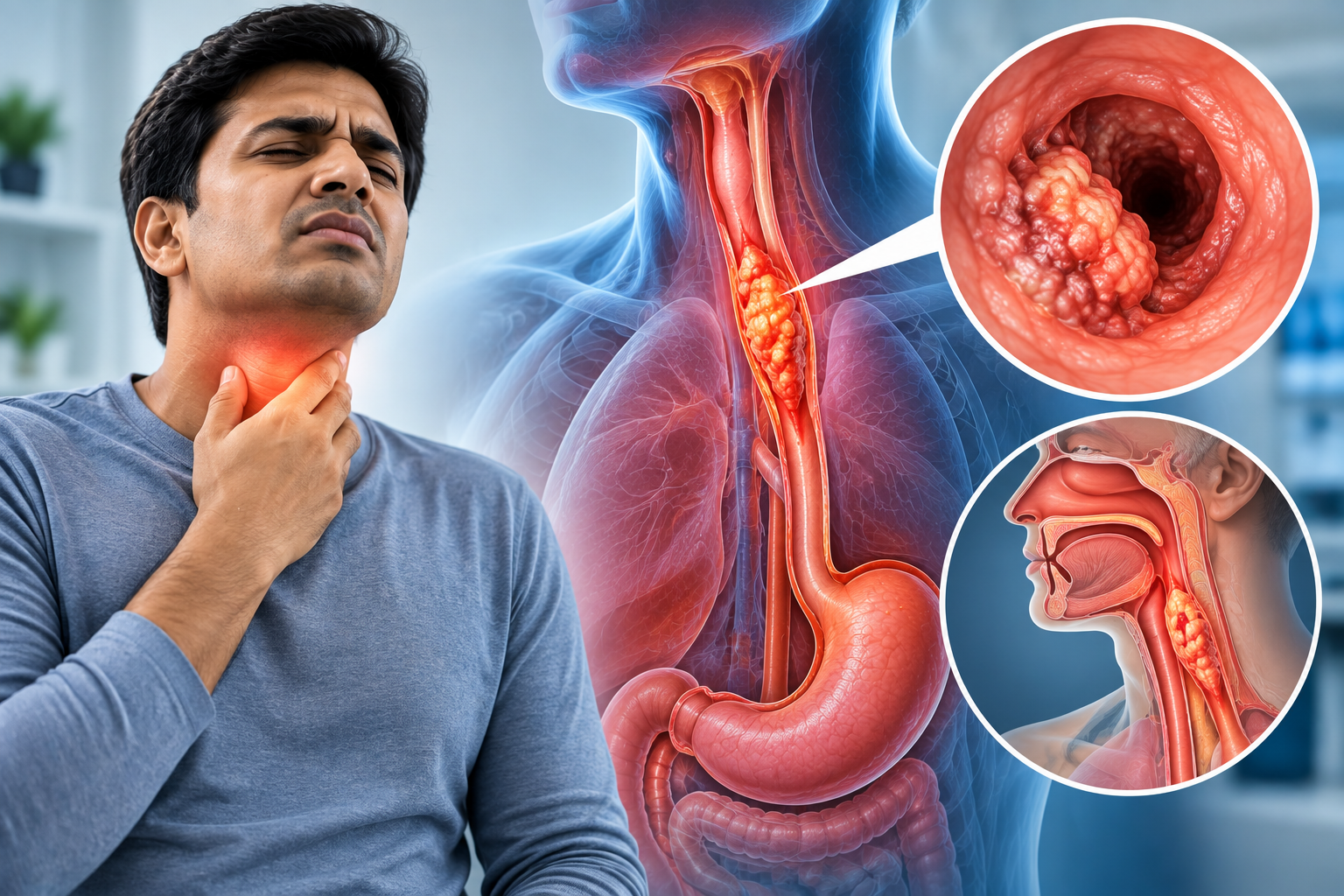

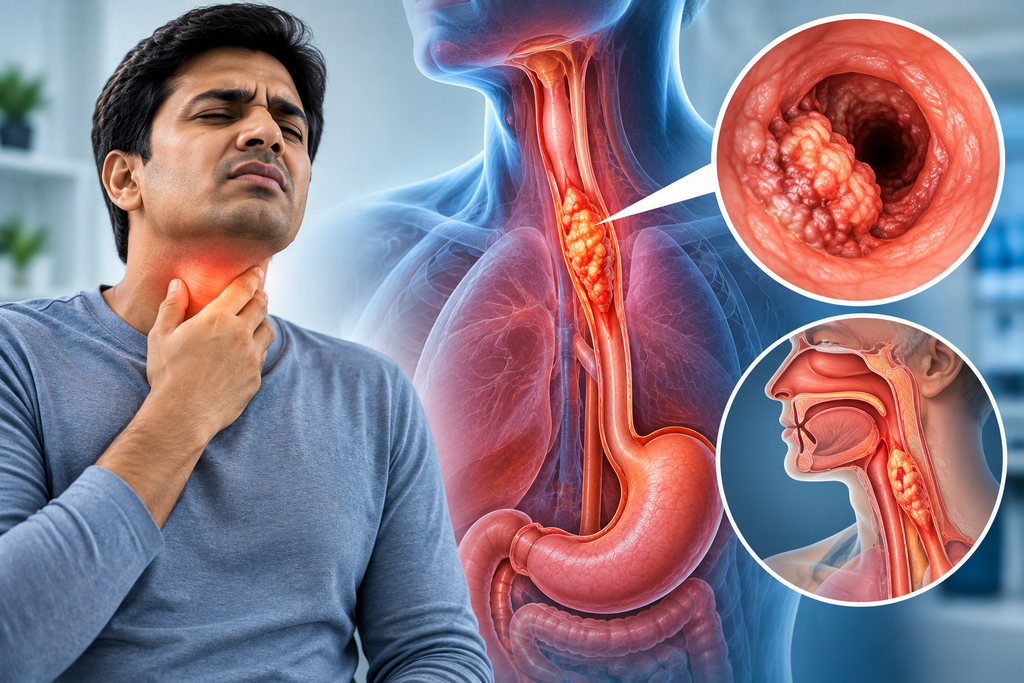
Imagine sitting down for a family meal and noticing that a piece of roti or rice takes a little longer to go down than usual, or seems to briefly catch in your chest. Most of the time, this happens once and is forgotten. But when that sensation keeps returning, or slowly gets worse over several weeks, it becomes something worth paying attention to.
The esophagus, often called the food pipe, is the muscular tube that carries food and liquid from the throat to the stomach. It works quietly in the background of every meal, and most of us never think about it until something feels different.
Difficulty swallowing, medically known as dysphagia, is one of the recognized symptoms associated with esophageal cancer. It is equally important to understand, right from the start, that dysphagia has many possible causes, and most of them are not cancer. What matters is not jumping to conclusions, but recognizing when a symptom is persistent or progressive enough to need a proper medical evaluation. An Esophageal Cancer Specialist in Cuttack can help identify the underlying cause of ongoing swallowing difficulty and guide the appropriate next steps.
What Is Esophageal Cancer?
The esophagus is lined by a layer of cells that helps food pass smoothly into the stomach. Esophageal cancer develops when abnormal cells begin to grow within this lining and multiply in an uncontrolled way, eventually forming a tumor.
There are two major types of esophageal cancer:
- Adenocarcinoma – usually arises in the lower part of the esophagus and is often linked to long-standing acid reflux and related changes in the esophageal lining
- Squamous cell carcinoma – can develop anywhere along the length of the esophagus and arises from the flat cells that line the organ
The tumor’s location, type, and depth of growth all influence how it is evaluated and treated. This is why a proper assessment by a specialist matters esophageal cancer is not managed the same way in every patient.
Difficulty Swallowing: An Important Warning Sign
Dysphagia refers to a sensation of food or liquid not passing normally from the mouth to the stomach. It can feel like food is sticking, moving too slowly, or requiring extra effort to swallow.
Doctors often look at whether the difficulty involves solids, liquids, or both, since this distinction is clinically useful:
- Difficulty that begins with solid foods (such as meat, bread, or rice) and gradually progresses to softer foods and eventually liquids is a pattern that specialists take note of
- Difficulty with liquids alone, or with both solids and liquids from the outset, often points toward a different group of causes, such as motility disorders
When an esophageal tumor grows, it can gradually narrow the internal passage of the esophagus, making it harder for food to move through. This is why progressive dysphagia swallowing difficulty that steadily worsens over time is taken seriously during medical evaluation. At the same time, dysphagia is a common symptom with several non-cancerous explanations, ranging from acid reflux to muscular or nerve-related swallowing disorders. Having difficulty swallowing does not mean a person has esophageal cancer.
Other Warning Signs of Esophageal Cancer
Along with dysphagia, several other symptoms may be associated with esophageal cancer, particularly when they occur together or persist over time:
- Difficulty or pain while swallowing (odynophagia)
- A sensation of food getting stuck in the chest or throat
- Unexplained weight loss
- Reduced or loss of appetite
- Persistent indigestion or heartburn
- Discomfort in the chest or upper abdomen
- Regurgitation of food or liquid
- Persistent cough or hoarseness in some cases
- Vomiting
- Ongoing fatigue or weakness
- Blood in vomit or other signs of gastrointestinal bleeding, generally seen in more advanced or complicated situations
Each of these symptoms, on its own, can result from several different conditions, many of them unrelated to cancer. In earlier stages, some patients may have few noticeable symptoms at all, which is one reason unexplained or persistent symptoms should not be dismissed.
When Should Difficulty Swallowing Be Evaluated?
As a general guide, swallowing difficulty that lasts more than a couple of weeks, or appears to be getting worse, should prompt a visit to a doctor. Situations that generally call for evaluation include:
- Difficulty swallowing that persists rather than resolving on its own
- Swallowing difficulty that is progressively worsening
- Difficulty that begins with solid food and gradually extends to softer foods or liquids
- Pain while swallowing
- Unexplained weight loss
- Recurrent vomiting
- Food repeatedly feeling stuck
- Persistent reflux or indigestion occurring alongside swallowing trouble
- Blood in vomit or other signs of gastrointestinal bleeding
- Ongoing chest or upper abdominal discomfort
Most people who experience occasional swallowing discomfort do not have esophageal cancer. However, persistent or evolving symptoms are best discussed with a gastrointestinal or cancer specialist so the underlying cause can be properly identified, rather than assumed.
What Causes Esophageal Cancer?
Esophageal cancer, like most cancers, does not have a single identifiable cause. Instead, certain factors are known to increase risk, including:
- Tobacco use, in any form
- Heavy or long-term alcohol consumption
- Chronic gastroesophageal reflux disease (GERD)
- Barrett’s esophagus, a condition in which the esophageal lining changes due to long-standing acid exposure
- Increasing age
- Certain dietary and nutritional factors
- Obesity, which is more closely linked to adenocarcinoma
- Certain inherited conditions or pre-existing esophageal conditions in some cases
Having one or more of these risk factors increases the statistical likelihood of developing esophageal cancer over a lifetime, but it does not mean a person will develop the disease. Many people with these risk factors never develop esophageal cancer, and some patients with no identifiable risk factors do.
How Is Esophageal Cancer Diagnosed?
Diagnosis typically follows a structured pathway, beginning with a detailed medical history and physical examination, followed by further investigations as needed:
- Upper gastrointestinal endoscopy (EGD): A thin, flexible camera is passed through the mouth to directly examine the esophagus, allowing the doctor to look for abnormal areas
- Biopsy: Small tissue samples may be taken during endoscopy for laboratory examination
- Imaging studies such as CT scans: Used to assess the extent of the tumor and check for spread
- PET-CT: Used in selected cases to evaluate spread beyond the esophagus
- Endoscopic ultrasound (EUS): Helps assess how deeply a tumor has grown into the esophageal wall and whether nearby lymph nodes are involved
- Additional tests: May be recommended depending on individual clinical findings
Note :- Not every patient requires every test listed above. The specific combination of investigations depends on individual symptoms, examination findings, and initial results. An experienced esophageal cancer specialist in Cuttack can guide which of these steps are relevant for a particular patient.
Why Is a Biopsy Important?
A biopsy involves taking a small sample of tissue from an area of concern during endoscopy, which is then examined under a microscope by a pathologist. This step matters because symptoms and imaging findings alone cannot confirm whether a tissue change is cancerous.
Biopsy findings help determine:
- Whether abnormal cells are present
- Whether those cells are cancerous
- Which type of esophageal cancer is present, if any
- Important tissue characteristics that can guide treatment planning
Biopsy and pathology results form a central part of confirming a diagnosis and shaping the treatment approach that follows.
Understanding Esophageal Cancer Stages
Once esophageal cancer is diagnosed, staging helps doctors understand the extent of the disease. Staging generally considers:
- How deeply the tumor has grown into the layers of the esophageal wall
- Whether nearby lymph nodes are involved
- Whether surrounding structures are affected
- Whether cancer has spread to distant organs
In broad terms, esophageal cancer may be described as early or localized disease, locally advanced disease, or metastatic disease, depending on how far it has spread. Staging is one of the most important factors in deciding which treatment approach is appropriate, since early and advanced disease are managed quite differently.
Treatment Options for Esophageal Cancer
There is no single, one-size-fits-all approach to treatment. Planning takes into account the cancer type, tumor location, stage, tumor size, lymph-node involvement, whether the disease has spread, the patient’s overall health, nutritional status, and suitability for different treatment modalities.
Surgery
In selected patients, surgery may be performed to remove the tumor along with the affected portion of the esophagus, followed by reconstruction of the digestive tract. Surgery is not appropriate for every patient and is generally considered based on stage, location, and overall fitness for the procedure.
Chemotherapy
Systemic chemotherapy may be used in selected patients sometimes before surgery to shrink the tumor, sometimes after surgery to reduce recurrence risk, and sometimes as the main treatment for more advanced disease. Specific drug choices and dosing are individualized decisions made by the treating oncology team.
Radiation Therapy
Radiation therapy uses targeted energy to treat cancer cells and may be used alone or alongside other treatments, depending on the stage and overall treatment plan.
Chemoradiation
Combined chemotherapy and radiation therapy, known as chemoradiation, may be used in selected patients, including some with locally advanced disease, either as a primary treatment or in preparation for surgery.
Targeted Therapy and Immunotherapy
For some advanced or biologically selected esophageal cancers, newer systemic treatments such as targeted therapy or immunotherapy may be considered, depending on specific tumor characteristics identified through testing. These treatments are not suitable for every patient and require individualized clinical assessment.
When Is Surgery Considered for Esophageal Cancer?
Surgery is one part of the overall treatment landscape, not a universal requirement. Several factors influence whether surgery is considered appropriate:
- The stage of the tumor at diagnosis
- The specific location of the tumor within the esophagus
- Whether nearby lymph nodes are involved
- The patient’s overall health and ability to tolerate surgery
- Nutritional status, since esophageal cancer can affect a patient’s ability to eat well before treatment
- Whether chemotherapy or chemoradiation is recommended before surgery to improve outcomes
Not every patient with esophageal cancer requires surgery, and treatment should be planned according to the cancer’s stage, location, biology and the patient’s overall health.
What Is Esophagectomy?
Esophagectomy refers to the surgical removal of part or most of the affected esophagus, followed by reconstruction of the digestive pathway, often using a portion of the stomach or intestine to restore continuity.
Different surgical approaches including open, laparoscopic, or robotic-assisted techniques may be used depending on tumor location and individual patient factors. No single approach is universally superior for every patient; the appropriate method is determined by the treating surgical team based on thorough evaluation.
What Happens After Esophageal Cancer Treatment?
Following treatment, ongoing follow-up care is an important part of the overall management plan. This typically includes:
- Regular medical follow-up visits
- Imaging or endoscopic monitoring when clinically appropriate
- Nutritional assessment and support
- Monitoring of swallowing and digestive function
- Watching for signs of recurrence
- Management of any treatment-related effects
- Support for lifestyle changes, including tobacco and alcohol cessation where relevant
Recovery experiences and timelines vary between individuals, and no specific outcome or timeline can be guaranteed for any patient.
Can Difficulty Swallowing Be Caused by Something Other Than Cancer?
This is one of the most important points for patients to understand: dysphagia is a common symptom with many possible causes that have nothing to do with cancer, including:
- Narrowing related to chronic GERD
- Esophageal stricture (a narrowed segment of the esophagus)
- Achalasia, a disorder affecting the esophageal muscles
- Inflammation of the esophagus (esophagitis)
- Esophageal rings or webs
- Motility disorders affecting normal swallowing coordination
- Other benign, non-cancerous conditions
Because symptoms alone cannot reliably distinguish between these causes, persistent dysphagia still warrants proper medical evaluation. This is precisely what allows the actual underlying cause to be identified.
When Is Difficulty Swallowing an Emergency?
Certain situations call for urgent medical attention rather than a routine appointment:
- Complete inability to swallow
- Food becoming completely stuck and not passing
- Difficulty breathing associated with a swallowing problem
- Significant or repeated vomiting
- Vomiting blood
- Black or tarry stools
- Severe weakness, dizziness, or fainting associated with possible bleeding
If any of these occur, prompt medical attention should be sought without delay.
Frequently Asked Questions
1. Is difficulty swallowing always a sign of esophageal cancer?
Ans :- No. Dysphagia has many possible causes, most of which are not cancer. Persistent or worsening difficulty swallowing should still be evaluated to determine the cause.
2. What are the early warning signs of esophageal cancer?
Ans :- Early signs can include mild or intermittent difficulty swallowing, a sensation of food moving slowly, indigestion, or mild chest discomfort. Some patients have few noticeable symptoms in early stages.
3. What causes difficulty swallowing?
Ans :- Causes range from acid reflux, esophageal stricture, and achalasia to inflammation, motility disorders, and, less commonly, esophageal tumors.
4. How is esophageal cancer diagnosed?
Ans :- Diagnosis typically involves a medical history and examination, upper GI endoscopy, biopsy, and imaging studies such as CT or PET-CT, depending on individual findings.
5. Is a biopsy required to diagnose esophageal cancer?
Ans :- Biopsy plays an important role in confirming many suspected cases of esophageal cancer, since tissue examination is generally needed to confirm whether cells are cancerous.
6. When does esophageal cancer require surgery?
Ans :- Surgery is considered for selected patients based on tumor stage, location, lymph-node involvement, and overall health. Not all patients are surgical candidates.
7. Can esophageal cancer be treated without surgery?
Ans :- Yes. Depending on the stage and individual factors, treatment may involve chemotherapy, radiation therapy, chemoradiation, or newer systemic therapies instead of, or before, surgery.
8. Which doctor should I consult for esophageal cancer in Cuttack?
Ans :- Persistent swallowing difficulty or related symptoms are generally evaluated by an experienced esophageal cancer specialist in Cuttack, typically a gastrointestinal or cancer surgeon familiar with diagnosing and managing esophageal conditions.
Conclusion
A meal shouldn’t feel like a challenge. When swallowing becomes consistently difficult or keeps getting worse, it’s a signal from the body worth listening to not ignoring, and not panicking over either. Seeking care from an Esophageal Cancer Treatment in Cuttack simply means getting a clear answer, whatever that answer turns out to be.
Difficulty swallowing is an important symptom, but it is only that — a symptom. It does not, by itself, confirm esophageal cancer. Dysphagia can arise from many conditions, ranging from acid reflux and esophageal stricture to motility disorders, and identifying the true cause requires proper evaluation rather than assumption.
Persistent Swallowing Trouble Shouldn’t Be Ignored
Living with ongoing swallowing difficulty can be unsettling, but it doesn’t have to remain unexplained. Consulting an Esophageal Cancer Specialist in Cuttack is a practical first step toward understanding what’s causing the symptom, rather than guessing or waiting it out. Identifying the underlying cause early allows appropriate care to begin sooner, whatever that cause turns out to be.
To summarize: difficulty swallowing is an important symptom that should not be ignored when persistent or progressively worsening. Dysphagia can result from many different conditions and does not, on its own, indicate cancer. Early medical evaluation helps identify the underlying cause accurately. Endoscopy and biopsy play a central role in diagnosing suspected esophageal cancer, and treatment decisions including whether surgery is appropriate depend on the cancer type, location, stage, and the patient’s overall health.
About Dr. Harish Chandra Mishra

Behind every diagnosis is a person someone navigating uncertainty, waiting for clarity, hoping for the right guidance at the right time. Dr. Harish Chandra Mishra approaches each patient with that understanding at the center of his practice.
As a Laparoscopic, Cancer & GI Surgeon based in Cuttack, Odisha, Dr. Mishra focuses on the surgical management of gastrointestinal and cancer-related conditions, including complex cases involving the esophagus, stomach, and digestive tract. His approach combines minimally invasive laparoscopic techniques with a broader focus on individualized cancer care recognizing that no two patients, and no two tumors, are exactly alike.
For patients in Cuttack and across Odisha facing a new diagnosis or an unexplained symptom, Dr. Mishra offers a starting point: a clear, honest conversation about what’s happening, what needs to be evaluated, and what the path forward might look like.
Dr. Harish Chandra Mishra
Laparoscopic, Cancer & GI Surgeon
Cuttack, Odisha
Book an Appointment
If you or a loved one is experiencing persistent difficulty swallowing, unexplained weight loss, recurrent vomiting, gastrointestinal bleeding, or other concerning symptoms, timely evaluation matters. Consulting an Esophageal Cancer Specialist can help determine the underlying cause and guide the appropriate next steps for diagnosis and care.
Book a consultation to discuss your symptoms and receive a proper clinical evaluation.
Visit Life Institute of Gastroenterology and Gynecology | Best 24/7 Surgical Hospital
Address :- Potapokhari, Block Chhaka, Naya Bazaar, Kataka, Odisha 753004

