


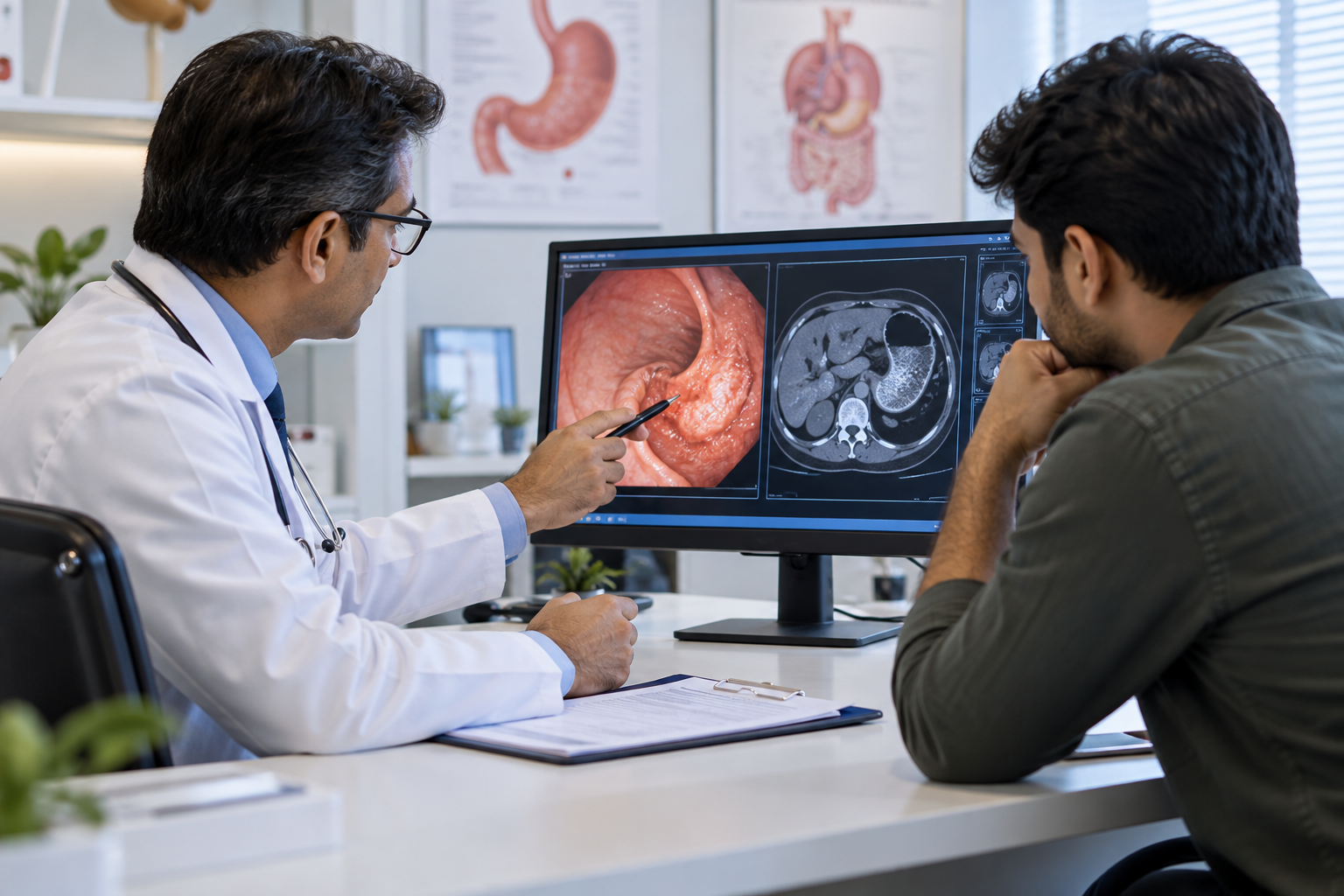

Stomach cancer, also known as gastric cancer, begins when abnormal cells grow uncontrollably in the lining of the stomach. It is a serious condition, but understanding its symptoms, risk factors, and the steps involved in diagnosis can help you have informed conversations with a doctor.
One of the challenges with stomach cancer is that early-stage disease often causes few or very nonspecific symptoms. In many cases, symptoms like indigestion, abdominal discomfort, or a feeling of fullness may be the first signs, but these complaints are extremely common and can have many causes. They do not automatically mean cancer. However, persistent, worsening, or unexplained digestive symptoms should be medically evaluated to identify the underlying cause.
For patients in Odisha seeking specialist care, understanding the pathway for Stomach Cancer Treatment in Cuttack can help demystify the process, from initial assessment to diagnosis and individualized treatment planning.
What Is Stomach Cancer?
The stomach is a muscular organ in the upper abdomen that receives food from the esophagus, mixes it with digestive juices, and passes it to the small intestine. Stomach cancer develops when cells in the stomach lining begin to grow abnormally and form a tumor.
The most common type of stomach cancer is adenocarcinoma, which starts in the glandular cells of the stomach lining. Other, less common types include lymphomas, gastrointestinal stromal tumors (GISTs), and neuroendocrine tumors. These different types can behave differently and may require distinct treatment approaches.
The location of the tumor within the stomach also matters. Cancers in the upper part of the stomach (near the esophagus) can cause different symptoms and may require different surgical approaches compared to tumors in the lower part.
Early Symptoms and Warning Signs of Stomach Cancer
Stomach cancer symptoms can overlap significantly with many common, non-cancerous digestive conditions. Early on, symptoms may be vague or absent. As the disease progresses, the following signs may appear:
- Persistent indigestion or a burning sensation in the upper abdomen
- Discomfort or pain in the upper abdomen
- Feeling full very quickly after eating only a small amount
- Loss of appetite
- Unexplained weight loss
- Nausea
- Vomiting
- Bloating, especially after meals
- Difficulty swallowing (dysphagia), if the tumor is in the upper stomach
- Heartburn or reflux-like symptoms
- Fatigue or weakness, which may be related to anemia from slow blood loss
- Black or tarry stools (melena), indicating gastrointestinal bleeding
- Vomiting blood, which can occur in advanced or complicated situations
It is important to emphasize that these symptoms do not automatically mean stomach cancer. Many common conditions, such as gastritis, peptic ulcers, and functional dyspepsia, can produce similar complaints. The key is whether symptoms are persistent, progressive, or unexplained.
When Should You See a Doctor?
You should consider scheduling a medical evaluation if you experience any of the following:
- Indigestion that persists for more than a few weeks and does not improve with initial measures
- Recurrent or worsening upper abdominal pain
- Unexplained weight loss
- Persistent vomiting
- Difficulty eating or swallowing
- Feeling unusually full after small meals
- Recurrent or unexplained gastrointestinal bleeding
- Black stools
- Persistent fatigue that may be associated with anemia
- Progressive symptoms in someone with a known stomach condition
Some situations require urgent medical attention rather than a routine appointment. These include vomiting blood, passing black or tarry stools along with weakness or dizziness, severe and persistent abdominal pain, repeated vomiting with an inability to keep fluids down, or fainting. These are potential emergencies and warrant immediate medical care.
What Are the Risk Factors for Stomach Cancer?
A risk factor is anything that increases the likelihood of developing a disease, but having one or more risk factors does not mean a person will definitely get cancer. Many people who develop stomach cancer have few or no known risk factors.
Recognized risk factors include:
- Helicobacter pylori (H. pylori) infection: A major risk factor, especially for cancers in the lower part of the stomach.
- Chronic gastritis: Long-standing inflammation of the stomach lining.
- Precancerous stomach conditions: Such as chronic atrophic gastritis and intestinal metaplasia.
- Family history: Having a first-degree relative with stomach cancer.
- Certain inherited genetic syndromes: Such as hereditary diffuse gastric cancer.
- Smoking: Smoking approximately doubles the risk.
- Diet: High intake of smoked, salted, pickled, or preserved foods, and low intake of fresh fruits and vegetables.
- Increasing age: Risk rises sharply after age 50.
- Previous stomach surgery: For non-cancerous conditions in selected circumstances.
Can H. pylori Infection Increase Stomach Cancer Risk?
Helicobacter pylori is a type of bacteria that can infect the stomach lining. It is very common worldwide and is a major cause of chronic gastritis, peptic ulcers, and is recognized as a primary risk factor for gastric adenocarcinoma, particularly cancers in the lower (distal) part of the stomach.
Long-term H. pylori infection can lead to chronic atrophic gastritis and precancerous changes in the stomach lining. Clinical guidelines recommend that H. pylori eradication therapy be offered to infected individuals as a strategy to reduce gastric cancer risk. However, it is important to understand that treating H. pylori does not completely eliminate the risk of stomach cancer, and it does not replace the need for appropriate medical evaluation if concerning symptoms are present.
How Is Stomach Cancer Diagnosed?
Diagnosing stomach cancer involves a stepwise approach. Not every patient requires every test; the evaluation is tailored to the individual.
- Medical history and physical examination: The doctor will ask about symptoms, risk factors, and family history, and will examine the abdomen.
- Blood tests: To check for anemia, which can result from slow bleeding, and to assess overall health.
- Upper gastrointestinal endoscopy (EGD): The most important test when stomach cancer is suspected. A thin, flexible tube with a camera is passed through the mouth to visualize the esophagus, stomach, and first part of the small intestine.
- Biopsy: During endoscopy, small tissue samples are taken from any suspicious areas and examined under a microscope to confirm the presence of cancer.
- CT scans: To assess the extent of the tumor and check for spread to nearby lymph nodes or distant organs.
- Endoscopic ultrasound (EUS): Can provide detailed information about how deeply a tumor has invaded the stomach wall.
- PET-CT: May be used in selected situations to detect distant spread.
Why Is Endoscopy Important?
Upper GI endoscopy allows a doctor to directly examine the lining of the esophagus, stomach, and upper small intestine. It is the most reliable way to visualize suspicious areas in the stomach. During the procedure, if abnormal tissue is seen, biopsy samples can be collected. Tissue examination is essential because symptoms and imaging alone cannot confirm a diagnosis of stomach cancer—only a pathologist’s review of the tissue can do that.
What Does a Stomach Cancer Biopsy Show?
A gastric biopsy provides critical information:
- Whether abnormal cells are cancerous
- The type of cancer (e.g., adenocarcinoma)
- Tumor characteristics that may influence treatment planning
In selected patients, additional molecular or biomarker testing may be performed on the biopsy tissue. This can identify characteristics such as HER2 status, PD-L1 expression, or microsatellite instability (MSI), which may help guide the use of targeted therapy or immunotherapy.
How Is Stomach Cancer Staged?
Staging determines how far the cancer has progressed. It helps doctors recommend the most appropriate treatment. The TNM system is commonly used:
- T (Tumor): How deeply the tumor has grown into the stomach wall.
- N (Nodes): Whether nearby lymph nodes are involved.
- M (Metastasis): Whether the cancer has spread to distant organs.
Based on this, stomach cancer is broadly categorized as:
- Early/localized disease: Cancer is confined to the stomach.
- Locally advanced disease: Cancer has grown into deeper layers or nearby lymph nodes.
- Metastatic disease: Cancer has spread to distant organs such as the liver or lungs.
Staging typically involves CT scans, endoscopic ultrasound, and sometimes PET-CT or staging laparoscopy.
Treatment Options for Stomach Cancer
Treatment for stomach cancer is highly individualized. It depends on the type, location, and stage of the cancer, whether it has spread, the patient’s overall health and nutritional status, and relevant tumor biomarkers.
Surgery
Surgery may be considered for selected patients when the cancer can be completely removed. The extent of surgery depends on the tumor’s location, size, and spread.
- Partial gastrectomy: Removal of part of the stomach. The remaining stomach is reconnected to the small intestine.
- Total gastrectomy: Removal of the entire stomach. The esophagus is joined directly to the small intestine.
- Lymph node removal: Nearby lymph nodes are often removed and examined for cancer cells.
Not every patient with stomach cancer requires surgery. Some tumors may not be resectable, and some patients may not be fit enough for major surgery.
Chemotherapy
Chemotherapy may be used before surgery (neoadjuvant), after surgery (adjuvant), or as the main treatment for advanced disease. It can help shrink tumors, reduce the risk of recurrence, or control cancer growth. Perioperative chemotherapy, given before and after surgery, is often recommended for resectable disease.
Radiation Therapy
Radiation therapy may be considered in selected circumstances, often in combination with chemotherapy, depending on the tumor and overall treatment strategy. It is not required for every patient.
Targeted Therapy
Some stomach cancers have specific molecular characteristics that may make targeted therapy relevant. For example, HER2-positive tumors may be treated with drugs that target that protein. Biomarker testing helps identify patients who might benefit.
Immunotherapy
Immunotherapy may be considered for selected patients depending on cancer type, stage, and biomarkers such as MSI-H/dMMR or PD-L1 expression. It is not universally effective for all stomach cancers.
When Does Stomach Cancer Require Surgery?
Surgery is most often considered when the cancer can be completely removed (resectable) and the patient is fit enough for the procedure. Key factors include:
- Resectability: Whether the tumor can be completely removed with clear margins.
- Tumor location: This influences the type of operation (partial vs. total gastrectomy).
- Lymph node involvement: If cancer has spread to lymph nodes, surgery may still be possible, often combined with chemotherapy.
- Disease spread: If cancer has spread to distant organs (metastatic disease), surgery is usually not curative, though it may be used to relieve symptoms such as bleeding or obstruction.
- Overall health: The patient’s general condition and nutritional status are important.
Not every patient with stomach cancer requires surgery. Treatment should be planned according to the stage, location, tumor characteristics, and overall health of the patient.
What Is a Gastrectomy?
A gastrectomy is the surgical removal of part or all of the stomach.
- Partial (subtotal) gastrectomy: Removal of the part of the stomach containing the tumor, along with nearby lymph nodes. The remaining stomach is joined to the small intestine.
- Total gastrectomy: Removal of the entire stomach, nearby lymph nodes, and parts of the esophagus and small intestine. The esophagus is reconnected to the small intestine.
Lymph node assessment during gastrectomy is an important part of cancer surgery. The surgical approach (open, laparoscopic, or robotic) depends on the patient’s disease and the treating surgical team’s assessment.
What Happens After Stomach Cancer Treatment?
After treatment, regular follow-up is important. This generally includes:
- Medical check-ups every 3–6 months for the first two years, then less frequently.
- Blood tests, including monitoring for anemia and nutritional deficiencies such as vitamin B12 and iron.
- Imaging or endoscopy when clinically appropriate.
- Monitoring nutritional status and dietary adjustments, especially after gastrectomy.
- Management of treatment-related effects.
Follow-up helps detect recurrence and manage any long-term effects of treatment.
When Is Stomach Cancer an Emergency?
Seek urgent medical attention if you experience:
- Blood Vomiting
- Black or tarry stools with signs of significant bleeding, such as weakness or dizziness
- Severe, persistent abdominal pain
- Repeated vomiting with inability to maintain hydration
- Fainting or severe weakness
These signs require immediate evaluation. Do not delay seeking care.
Frequently Asked Questions About Stomach Cancer Treatment
1. What are the early warning signs of stomach cancer?
Ans :- Early stomach cancer often causes no symptoms or only vague ones like indigestion, mild abdominal discomfort, or feeling full quickly. Persistent or unexplained symptoms should be evaluated.
2. Can indigestion be a sign of stomach cancer?
Ans :- Yes, persistent indigestion can be a symptom, but it is far more commonly caused by benign conditions like gastritis or GERD. Persistent indigestion warrants medical evaluation.
3. Does H. pylori cause stomach cancer?
Ans :- H. pylori infection is a major risk factor for stomach cancer, particularly distal gastric cancer. However, most people with H. pylori never develop cancer.
4. How is stomach cancer diagnosed?
Ans :- Diagnosis typically involves upper GI endoscopy with biopsy. Imaging tests such as CT scans and endoscopic ultrasound are used for staging.
5. Is endoscopy necessary to diagnose stomach cancer?
Ans :- Yes, upper GI endoscopy with biopsy is the standard method for confirming a diagnosis of stomach cancer.
6. When does stomach cancer require surgery?
Ans :- Surgery is considered when the cancer can be completely removed and the patient is fit enough. Not every patient requires surgery.
7. Can stomach cancer be treated without surgery?
Ans :- Yes, for some patients particularly those with advanced disease or who are not fit for surgery chemotherapy, targeted therapy, immunotherapy, or radiation may be treatment options.
8. Which doctor should I consult for stomach cancer in Cuttack?
Ans :- You should consult a gastroenterologist, surgical oncologist, or GI cancer surgeon. For Stomach Cancer Treatment, seek evaluation from a qualified specialist experienced in gastric cancer management.
Conclusion
Stomach cancer can cause symptoms that overlap with common digestive disorders, which is why persistent, progressive, or unexplained symptoms should be medically evaluated. Endoscopy and biopsy are essential for diagnosis. Risk factors such as H. pylori infection, smoking, and certain stomach conditions can increase risk, but they do not establish a diagnosis. Treatment depends on the cancer type, stage, location, tumor characteristics, and the patient’s overall health. Surgery is appropriate for selected patients and may be combined with chemotherapy, radiation, targeted therapy, or immunotherapy. For individuals in Odisha, Stomach Cancer Treatment in Cuttack offers access to specialist evaluation and individualized care planning.
About Dr. Harish Chandra Mishra

Behind every diagnosis is a person someone navigating uncertainty, waiting for clarity, hoping for the right guidance at the right time. Dr. Harish Chandra Mishra approaches each patient with that understanding at the center of his practice.
As a Laparoscopic, Cancer & GI Surgeon Dr. Mishra focuses on the surgical management of gastrointestinal and cancer-related conditions, including complex cases involving the esophagus, stomach, and digestive tract. His approach combines minimally invasive laparoscopic techniques with a broader focus on individualized cancer care recognizing that no two patients, and no two tumors, are exactly alike.
Book an Appointment
If you are experiencing persistent digestive symptoms, unexplained weight loss, gastrointestinal bleeding, or other concerning symptoms, seeking appropriate specialist evaluation is a responsible step. Consult a Stomach Cancer Specialist in Cuttack for a thorough assessment and personalized guidance. Early evaluation can help identify the cause of your symptoms and ensure you receive the care you need.
Visit Life Institute of Gastroenterology and Gynecology | Best 24/7 Surgical Hospital
Address :- Potapokhari, Block Chhaka, Naya Bazaar, Kataka, Odisha 753004

