


what are the causes of stomach cancer?

- infection with the bacteria Helicobacter pylori. a diet high in smoked, pickled, and salted foods and low in fresh fruit and vegetables. alcohol consumption.being overweight or obese.
What are the types of Stomach cancer?
- Stomach cancer is sometimes called gastric cancer.
- Worldwide it is one of the most common cancers.
- Stomach cancer is more common in men than in women.
- It tends to occur mainly in older people (Most are over the age of 55).
Adenocarcinoma of the stomach :
- This is the most common type of stomach cancer.
- It begins from a cell that is on the inside lining of the stomach (the mucosa).
Less common cancers that can affect the stomach :
- Lymphomas, for example, mucosa-associated lymphoid tissue (MALT) lymphomas
- Soft tissue sarcomas, for example, gastrointestinal stromal tumors (GISTs)
- Neuroendocrine tumors (NETS)
- Carcinoid tumors
- Gastro-oesophageal junction cancer (GOJ) – This develops where your food pipe (esophagus) joins the stomach. GOJ can be treated like a stomach or an oesophageal cancer, depending on where the cancer is.
What is the function of the stomach?
- The stomach is part of your digestive system.
- It is a hollow organ like a bag that goes from the end of your esophagus (food pipe) to the start of your small bowel (small intestine).
- After food is swallowed, your stomach mixes and churns it with the help of chemicals so that it leaves your stomach in a semi-solid form.
- The lining of your stomach wall has four layers: the mucosa, the submucosa, a muscle layer, and an outer layer called the serosa.
- In the mucosa, glands make chemicals, such as enzymes and acids, to help break down food.
- The stomach also makes a type of protein called intrinsic factor – which helps to absorb vitamin B12. This vitamin is needed for red blood cells to grow and for your nervous system to work properly.
What causes/ Risk factors for stomach cancer?
- Many people develop stomach cancer for no apparent reason.
- However, certain risk factors increase the chance of stomach cancer including a History of gastrectomy/antrectomy / GJ
Stomach cancer symptoms.
- When it first develops and is small – no symptoms.
- When advanced: symptoms include: –
- Upper abdomen Pain or discomfort -especially after eating
- Postprandial fullness
- Bleeding from Tumor
- Blood vomiting
- Black faeces (melaena)
- Anemic (low Hb%)
- Vomiting (Feeling sick )
- Indigestion
- Decreased food intake
- Weight loss (10%, in 6 months)
- Loss of appetite.
- When Cancer grows very large or is near the pyloric opening or at the GE junction – it causes a blockage (vomiting all solid and liquid food).
- If the cancer spreads to other parts of the body (Metastatic) :
- Ascites
- Complete & diffuse intestinal obstruction
- Virchow’s node (Neck)/ Irish Nodes (Axilla)
- Sister Mary Joseph Node (Umbilicus)
- Liver / Lungs metastasis
How is stomach cancer diagnosed and assessed?
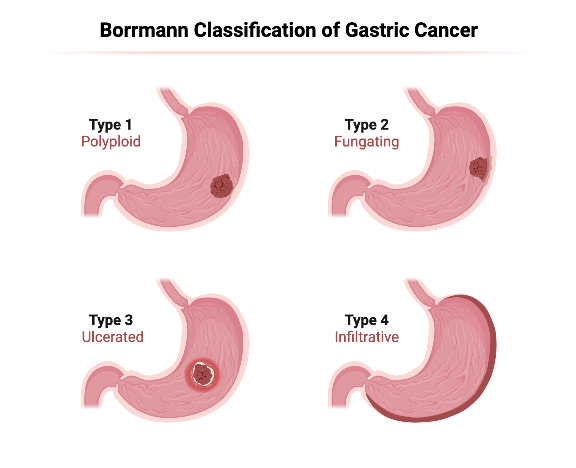
Borromann classification.
- Polypoid or fungating.
- Ulcerating lesions with elevated borders.
- Ulcerating with the innovation of wall.
- Diffuse Infiltration (Linitist Plastica).
- Cannot be Classified
Upper GI Endoscopy :
- Initial assessment – Site, size, and shape of the cancerous growth
- Biopsy – to confirm the diagnosis, is a must before chemotherapy
Assessing the extent and spread :
- Ultrasound of the abdomen and pelvis
- Computerized Tomography (CT) scan
- Endoscopic Ultrasonography.
- Staging Laparoscopy
- Spread to local lymph nodes.
- Spread to other areas of the body / Liver (metastasis).
- It also gives a reasonable indication of outlook (prognosis).
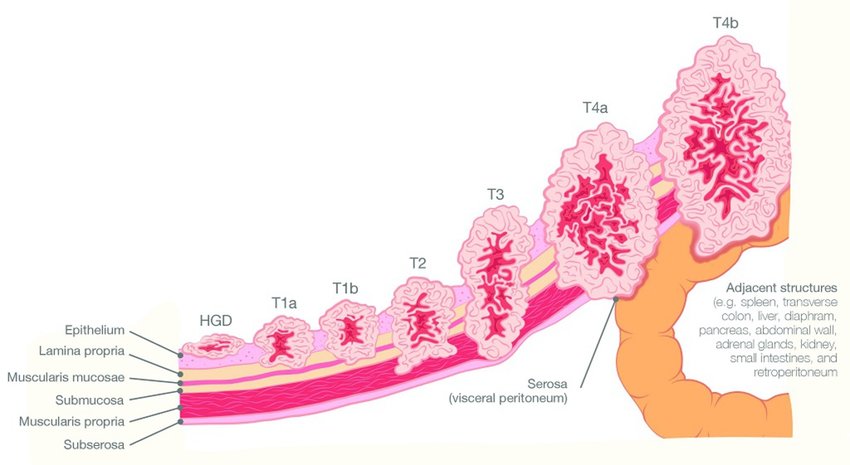
- Tumor growth through the wall of the stomach – partially or fully
TNM Staging of stomach cancer
How stomach cancer is treated?

Factors deciding the mode of treatment:
- How large the cancer is.
- Whether it has spread (stage)
- Your general health – CVS, co-morbidities
- Nutritional status
Have a full discussion with a specialist:
- Pros and cons
- Likely success rate
- Possible side-effects
- Other possible treatment options
Aims of treatment :
- Aim to cure the cancer (Curative) – early stages of the disease ( Remission means there is no evidence of cancer following treatment. If you are in remission, you may be cured. However, in some cases, cancer returns months or years later. This is why doctors are sometimes reluctant to use the word cured.) – with surgery / Surgery + Chemotherapy.
- Aim to control the cancer – limit the growth or spread of the cancer so that it progresses less rapidly. This may keep you free of symptoms for some time.
- Aim to ease symptoms (Palliative)- If a cure is not possible, treatments may be used to reduce the size of the cancer, which may ease symptoms such as pain. If the cancer is advanced, you may require treatments such as Food supplements, Painkillers, and Appetizers.
Surgery :
- Removing the tumor – cut out the affected part of the stomach –Distal / Total Gastrectomy
- Curative if the cancer is in an early stage.
- Sometimes the whole of the stomach is removed.
- Sometimes this is done laparoscopically.
- Even if in advanced stages cure is not possible, Surgery will ease symptoms (bypass operation- gastrojejunostomy).
Chemotherapy :
(FLOT, 5FU+ Cisplatin, 21days gap, 6cycles)
- Anti-cancer medicines – kill cancer cells or stop them from multiplying.
- Adjuvant chemotherapy – used in addition to surgery (post-operative).
- This aims to kill any cancer cells which may have spread away from the primary tumor.
- Neoadjuvant chemotherapy – Given before surgery (to shrink a large tumor ).
Radiotherapy :
- High-energy beams of radiation which are focused on cancerous tissue.
- Radiotherapy is not commonly used to treat stomach cancer.
- It is sometimes used to reduce the size of a particular part of the cancer that is causing symptoms.
- Chemoradiotherapy – used in some cases, often as an addition to surgery.
Stomach cancer prognosis/life after diagnosis?
- Without treatment, stomach (gastric) cancer is likely to get larger and spread to other parts of the body.
- If it is diagnosed and treated at an early stage (before growing through the wall of the stomach or spreading to lymph nodes or other areas of the body) then there is a good chance of a cure with surgery. Unfortunately, most cases are not diagnosed at an early stage.
- If the cancer is diagnosed when it has grown through the wall of the stomach, or spread to other parts of the body, a cure is less likely. However, treatment can often slow down the progression of the cancer, using chemotherapy medicines.
- The specialist who knows your case can give more accurate information about your particular outlook, and how well your type and stage of cancer is likely to respond to treatment.
- Overall 5-year Survival rate – approx. 30% ( varies from 71 % → 4%)
Frequently asked questions in stomach cancer :
1. How long does it take to recover from stomach cancer surgery?
- Any type of surgery for stomach cancer will involve a large operation and a long recovery time. If you have stomach cancer surgery, you’ll usually need to stay in the hospital for around 2 weeks. You’ll also need several weeks at home to recover.
2. Can you live if you have your stomach removed?
- Stomach: The whole stomach is sometimes removed as a treatment for stomach cancer, a procedure called a total gastrectomy. In this procedure, the small intestine is connected to the esophagus. So you have to have small and frequent meals.
3. Is stomach cancer usually fatal?
- It is a slow-growing cancer that may grow for many years before symptoms
are felt. Stomach cancer can spread through the stomach wall to nearby
organs, such as the liver, pancreas, or large bowel.
4. How long can you live with stomach cancer?
- The five-year survival rate for stage IA stomach cancer is 71%, meaning 71 % of people diagnosed with stage IA stomach cancer survive >/= 5 years. On the flip side, 29 % of people diagnosed with stage 1A stomach cancer live for less than five years.
5. Can you survive stomach cancer?
- If healthcare providers find stomach cancer in the early stages when the cancer is still only in the stomach, the five-year survival rate is about 65-70%. If they find stomach cancer when it’s spread to areas near your stomach or to nearby lymph nodes, the five-year survival rate is about 30%.
If you need any consultancy Talk to us.

